Chapter 2 is about looking around before moving ahead. These examples show how Nodes explored their context, brought together different perspectives and organised a practical first step.
The examples are linked to one or two topics from chapter 2:
Node context: why the Node context matters
Context overview: what to include in a first overview
Connections and gaps: what is connected, unclear or missing
Initial team: who should be involved at the start
Ways of working: how to organise the work together
The examples are organised alphabetically by Node. Use the topics to find examples that connect to the chapter exercises.
ELIXIR Germany: fitting the strategy to a distributed Node
Node: ELIXIR Germany
Authors: Helena Schnitzer, training platform coordinator and liaison for RDM related questions
Topics: Node context
A Node strategy should complement existing institutional approaches rather than replace them. Shared direction does not require one uniform approach across all partner institutions.
ELIXIR Germany is a distributed Node with several partner institutions contributing expertise, services and activities. This structure is an important factor when considering a Node Data Management Strategy.
A strategy at Node level needs to complement existing institutional approaches and not replace them. Partner institutions already operate within their own organisational frameworks, with different priorities, resources and strategic processes.
Therefore, a Node Data Management Strategy needs to provide a shared direction while remaining flexible enough to be relevant for different institutional contexts. The focus is not on creating one uniform approach, but on identifying common goals and principles that can support collaboration across the Node, while also clarifying and acknowledging institutional differences.
ELIXIR Germany: linking Node strategy, services and activities
Node: ELIXIR Germany
Authors: Helena Schnitzer, training platform coordinator and liaison for RDM related questions
Topics: Context overview, Connections and gaps
Link strategic priorities to existing services, training and expertise. This can make current contributions more visible and support the development of the Node Service Delivery Plan.
A key aspect of understanding the Node context is connecting strategic objectives with existing activities. ELIXIR Germany contributes to a range of services, cloud infrastructures and training activities that support researchers.
The Node Service Delivery Plan provides an overview of services that contribute to the implementation of the Node’s strategic objectives. Its continued development builds on established processes, including documented criteria for the inclusion of services, while allowing the service portfolio to evolve alongside the needs of the Node and the wider ELIXIR ecosystem.
To make these connections more explicit, the plan is to describe how existing services, training activities and expertise contribute to broader research data management goals. This also supports the continuous development of our Node Service Delivery Plan by providing a clearer link between strategic priorities and available resources.
Looking ahead, ELIXIR Germany is currently developing an internal five-year Node Strategy. Research data management, together with the associated services, training activities and expertise, is expected to form an important component of this strategic planning process. This provides an opportunity to further strengthen the alignment between the Node Strategy and future Node activities.
ELIXIR Netherlands: bringing together Node and institutional perspectives
Node: ELIXIR Netherlands
Authors: Mijke Jetten, data stewardship liaison and deputy training coordinator
Topics: Node context, Initial team
Start with two or three people who see the Node from different perspectives. They do not need to represent the whole Node, but they can help identify who is essential now and who can be involved later.
After appointing a data stewardship liaison, ELIXIR Netherlands needed to explore the responsibilities of the new role and how it could connect data stewardship activities across the distributed Node. No single person had a complete view of the work taking place across the Node, its organisations and its links with wider national and European initiatives.
We started with a small group consisting of the Head of Node, the data stewardship liaison and a data management expert from one university medical centre. The Head of Node brought the overarching Node perspective, while the institutional expert understood where data stewardship activities happen in practice. Bringing them together was already useful, as they had not previously worked together directly.
The first group was not intended to represent the whole Node. It helped us identify who should be involved next, including the Node Coordinator, Technical Coordinator, Training Coordinator, AI liaison, communications support and people involved in ELIXIR Platforms, Communities and Focus Groups. We also recognised that more institutional representatives may be needed to understand how the Node and its activities are perceived locally.
ELIXIR Netherlands: using an initial meeting to identify priorities
Node: ELIXIR Netherlands
Authors: Mijke Jetten, data stewardship liaison and deputy training coordinator
Topics: Initial team, Ways of working
The initial meeting does not need to produce a complete strategy. Use it to compare perspectives, identify first priorities and agree on an immediate next step.
The first meeting was organised to discuss the responsibilities and initial priorities of the newly appointed data stewardship liaison, rather than to write a Node data management strategy. The meeting brought together the Head of Node, the data stewardship liaison and a data management expert from one university medical centre.
The meeting started with introductions and an explanation of the liaison role. We then reviewed the new ELIXIR Netherlands strategy and an earlier mapping based on the RDA GORC model. The main discussion focused on two questions: which quick wins could be taken forward and which topics should receive priority.
After the meeting, the data stewardship liaison prepared an action plan rather than a full strategy. This was a more realistic first outcome and created a practical basis for further discussion, feedback and coordination.
ELIXIR Netherlands: finding practical ways to keep people involved
Node: ELIXIR Netherlands
Authors: Mijke Jetten, data stewardship liaison and deputy training coordinator
Topics: Ways of working
Do not rely on one way of involving people. Offer practical options that fit existing ways of working, such as comments in a document, discussion during a regular meeting or a separate follow-up meeting.
After the initial meeting, the data stewardship liaison prepared a summary and an action plan and shared them with the wider Node coordination team. The aim was to keep the relevant people informed and give them an opportunity to help shape the next steps.
Different ways to provide input were offered. People could add comments or tracked changes to the document, discuss the work during an existing meeting or join a separate meeting if that was more useful. Practical tasks would also be added to the shared Taiga board used to work on actions from the ELIXIR Netherlands strategy.
A remaining challenge is to find a manageable way to keep people involved, make the work a joint responsibility and still turn it into practical actions. Progress may be gradual, as this is not a priority for everyone, but starting the conversation already created a useful basis for further work.
ELIXIR Spain: understanding the Node RDM landscape and needs
Node: ELIXIR Spain
Authors: Aída Moure, RDM liaison
Topics: Context overview, Connections and gaps
Use a survey to gather input across the Node. Responses can show what is already working, where awareness is limited and which training needs differ between groups.
In order to capture Research Data Management (RDM) practices and challenges within the ELIXIR-ES we created and distributed an RDM survey to all Research Groups and Institutions involved in the Service Delivery Plan (SDP) across the Spanish Node, as stated in the examples of Chapter 1. So far we have 12 responses, which represent about 44% of the Node’s Research Groups. The survey considered aspects such as the link between Services from the SDP and the RDM data life cycle, the use and knowledge of RDM practices, resources and tools as well as possible specific training needs across institutions and research groups.
In terms of findings, the SDP services covered in the survey relate to most stages of the RDM data lifecycle. All respondents confirmed that their Research Group uses RDM practices - mainly trusted repositories, regular data backups and data management plans (DMP). For DMP, there is a mix between the use of project-specific and institution/group-specific templates. RDMkit is the most commonly used ELIXIR tool among respondents, although there seems to be limited awareness or use of other ELIXIR tools. Some respondents were not aware of the RDM community, while others knew about it and expressed interest in participating. Training needs were highlighted by all respondents, mainly focusing on DMPs, RDM and the data lifecycle, and FAIR practices. A few also mentioned interest in training on ethical aspects of RDM and more advanced interoperability concepts. Some Research Groups expressed interest in beginner-level while others requested more advanced training.
The overall picture shows that good RDM practices are already well established in the Spanish Node, but there is room to improve awareness and use of ELIXIR tools, resources, and key RDM concepts such as the data lifecycle, which would be welcome in terms of data harmonisation and quality. Solid training on specific RDM topics, together with greater visibility of ELIXIR tools and resources, would help strengthen the RDM strategy and landscape across the Node. Further steps will be considered to achieve this.
ELIXIR Sweden: mapping the data service landscape
Node: ELIXIR Sweden
Authors: Elin Kronander and Niclas Jareborg, heads of data management
Topics: Context overview, Connections and gaps
Create the overview together. Mapping services in an in-person workshop can reveal connections and gaps that are difficult to identify from separate lists.
The Swedish node in ELIXIR is constituted by NBIS (National Bioinformatics Infrastructure Sweden) which is a national research infrastructure providing bioinformatics and data science support to the Swedish life science research community. NBIS is also the bioinformatics platform for SciLifeLab, the distributed national research infrastructure for molecular biosciences in Sweden.
Within SciLifeLab, RDM services are offered by both a Data management unit in NBIS and by SciLifeLab Data Centre, which is a central function within SciLifeLab. The two functions are separate organisational entities but collaborate quite a lot to provide RDM support to Swedish life science researchers. They have different remits, but are to some extent dependent on each other for delivering these services. And even though communication works well, there were gaps in understanding the teams of what relevant services were operated or being developed by one or the other.
To tackle this, we organised a workshop to visualise the landscape of existing and emerging RDM-related services. Practically, we gathered staff from both NBIS and Data Centre that were asked to write down all services that they could think of on sticky notes. The sticky notes were colour coded based on who was the service provider and whether it was an existing or emerging service. They were then placed on a representation of the research data life cycle to visualise which parts of the life cycle the services targeted.
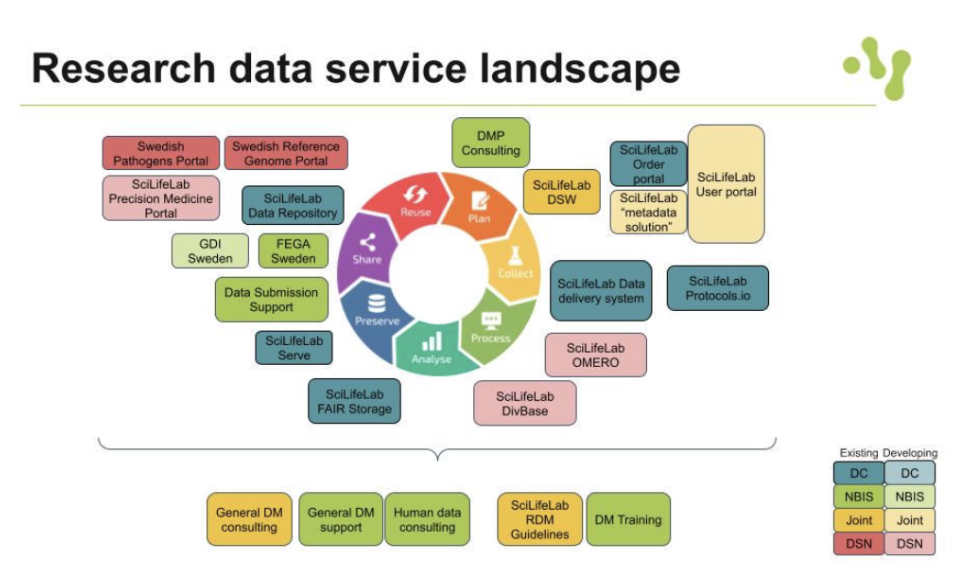
Figure: Swedish research data services mapped across the research data life cycle. Source: ELIXIR Sweden.
Creating this joint visual map in an in-person group setting helped establishing a shared understanding of the landscape of the available service across the two groups that we operate to be able to provide our joint support functionality.