The Global Open Research Commons (GORC) framework provides a shared way to describe the different parts of a research commons.
The full International Model is detailed, but you do not need to use it all at once. Its essential elements provide a practical starting point for understanding how infrastructure, services, governance and people work together.
Why is this relevant?
A research commons brings together the resources, services, people and agreements needed to support research. This may include research data, software, publications, technical infrastructure, tools, standards, governance, expertise and community support.
A research commons is therefore more than a collection of technical services. Its effectiveness also depends on the people, rules and organisational structures that allow resources and services to be developed, maintained and used.
The GORC framework was developed through the Research Data Alliance to provide a common language and structure for describing these different elements. It can support discussion of needs and priorities, coordination between infrastructures and communities and comparison between different research commons.
For a Node data management strategy, this broader view is useful. It helps you look beyond individual services or projects and consider how technical, organisational and human elements connect.
What can Nodes learn from this?
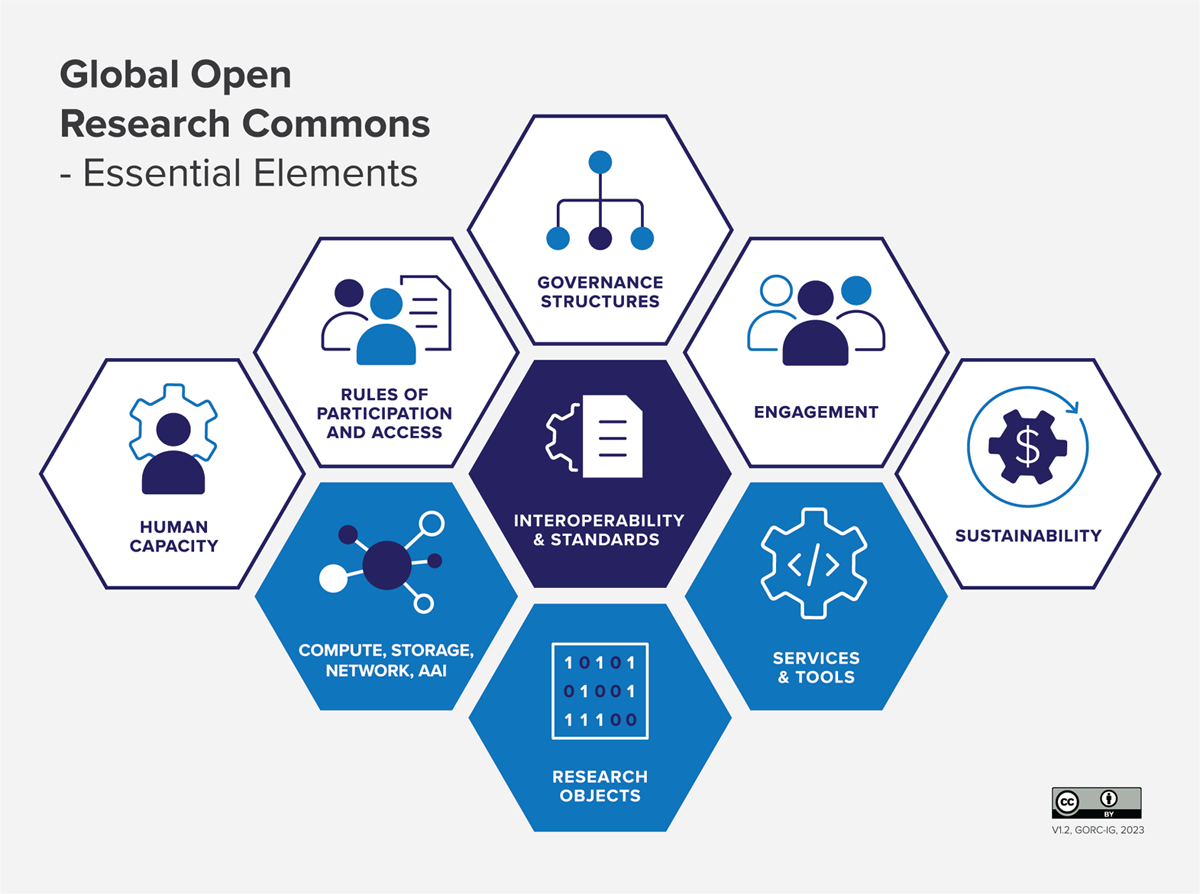
Figure: GORC essential elements. Source: GORC IG Typology and Definitions Diagram, licensed under CC BY 4.0.
-
A research commons is more than infrastructure. It brings together research objects, technical infrastructure, services, people and agreements. Its effectiveness depends on how these parts support each other.
-
The essential elements form one connected system. The original GORC typology presents nine broad elements covering technical, organisational and human aspects.
-
The nine elements provide a practical structure. These are compute, storage, network and authentication and authorisation infrastructure (AAI), services and tools, research objects, interoperability and standards, governance structures, rules of participation and access, engagement, human capacity and sustainability.
-
Technical and organisational elements are interdependent. Services depend on infrastructure, standards, expertise and sustainable resources. Research objects depend on standards, tools and clear access arrangements. Governance influences priorities and responsibilities, while engagement helps ensure that services respond to community needs.
-
The visual provides a practical starting point. It helps you review your Node context without working through the full model. It also makes connections between activities, roles and resources more visible.
-
The detailed International Model goes further. Version 1.1 separates interoperability from standards and conventions, resulting in ten main sections. It also adds detailed categories, attributes, features and possible indicators.
-
GORC is descriptive, not prescriptive. It is not a certification or ranking system and does not require every element to be addressed in the same way. It provides a structure for discussion, reflection and priority setting.
What can you do?
Use the visual to review your Node context.
Consider:
- which elements are already visible
- which activities relate to more than one element
- which areas have not yet been considered
- which elements are most relevant to your strategy
Start with the essential elements. Use the detailed International Model only when you need to explore a particular area more closely.
Return to What to include in your Node data management strategy to apply the framework.