
Consistent branding is essential for building trust and recognition, both within ELIXIR and in the wider research community. When your Node communicates as part of ELIXIR, using the correct logos, colours and templates is more than a visual choice – it signals a cohesive voice, a recognisable brand and a professional standard.
Good design is also accessible design. This chapter covers branding; for contrast, ALT text, readable structure and the difference between an image and text-that-should-be-text, see Chapter 5: Accessibility — it applies to everything you produce, including the materials you design here.
Digital identity and branding
Why it matters
- Consistent branding strengthens your Node’s identity and reinforces the value of being part of a respected European infrastructure.
- It helps audiences – whether researchers, policymakers or funders – immediately recognise your work as part of the ELIXIR network.
Best practices
- Always use the official ELIXIR logo and colour palette in presentations, reports and digital materials.
- Use Open Sans for slides, documents, posters and print, and Lato for websites.
- Follow the ELIXIR Style Guide for writing conventions. This ensures a unified voice across all Nodes.
- When in doubt, check the ELIXIR Brand Guidelines for the rules, and download the latest logos and visuals from the intranet branding page.
Which logo, when?
The Brand Guidelines define one simple rule of thumb: the logo follows who the activity belongs to.
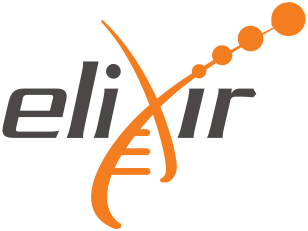
Main ELIXIR logo
Activities involving more than one Node, and anything about ELIXIR as a whole.
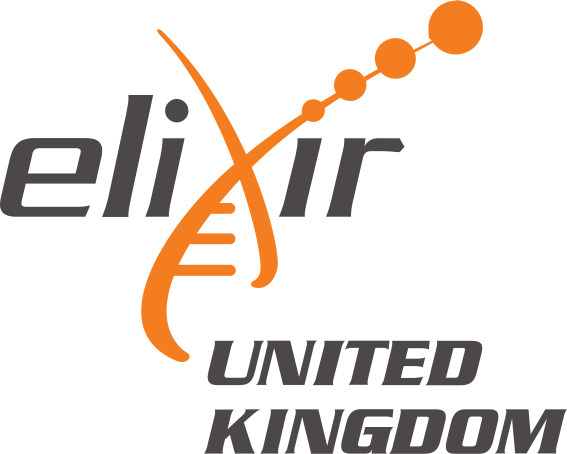
Node logo – standard
Your Node's own slides, posters and documents. The default choice.
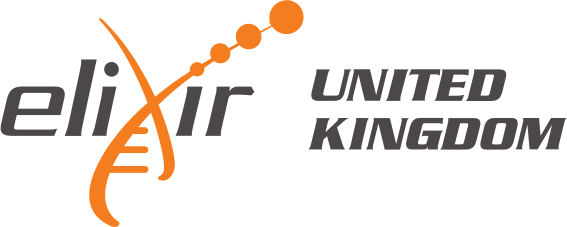

Node logo – horizontal
When the country name would be too small in the standard version.

Helix only
Favicons and very small spaces where the full logo can't be read.
ELIXIR UK is shown as the example Node. Always download the official files – every Node's logo, in every version – from the intranet branding page.
Every logo comes in three versions (Brand Guidelines, p. 8): standard for light backgrounds, negative for dark ones and full white for coloured ones such as orange. Two placement rules make the biggest difference:
- Give it space. Keep a clear margin around the logo on every side, at least as wide as the “el” in “elixir” – no text, images or other logos inside it (p. 11).
- Keep the background calm. Don’t place the logo over busy photos; use a plain area or a solid colour behind it (p. 8).
| Situation | Use | Avoid |
|---|---|---|
| Your Node’s own slides, posters, documents | Your Node logo (standard square version; horizontal if the country name gets too small) | Recolouring or redrawing any part of it |
| An activity involving more than one Node | The main ELIXIR logo – the Brand Guidelines’ rule. If each Node needs to be named (for a funder, say), list them in text beside it: “with ELIXIR Belgium, ELIXIR Netherlands and ELIXIR UK” | A row of Node logos – each one already contains the ELIXIR logo, so the row repeats the same helix and wordmark again and again |
| Your Node working with an external partner | Your Node logo alongside the partner’s logo | Placing the Node logo next to the main ELIXIR logo – it already contains it |
| Small spaces (favicons, tiny icons) | The helix only | Squashing the full logo |
Getting the combination right
Node logo next to the main ELIXIR logo
The Node logo already contains the ELIXIR logo, so the pair just repeats it.
Node logo beside the partner's
Partner logoFor a joint activity with an external partner, your Node logo sits alongside theirs.
The fastest route to an on-brand output is not designing from scratch – it’s starting from an approved template and only changing what you need to. The ELIXIR slide and document templates are on the ELIXIR Google Drive, and the roll-up banner template is on the intranet – swap in your Node logo and you’re done.
When you can’t use full branding
Applying the full ELIXIR branding is the default, but it isn’t always the right call. Two situations come up regularly.
1. Joint and co-organised activities
Sometimes you’ll prepare materials for a joint event with another organisation that has its own guidelines, so you can’t apply the full ELIXIR branding. In these cases, make sure you still use the correct logo and clear messaging that shows ELIXIR’s involvement.
- If your Node is organising or co-organising the activity, add your Node logo alongside the partner’s.
- If several Nodes are involved, use the main ELIXIR logo rather than listing each Node’s.
The key is to adapt, not abandon: keep the messaging clear and make sure ELIXIR’s involvement is unmistakable even within someone else’s visual style.
ELIXIR-UK co-organised this hackathon while HDR UK led and funded most of it – so the materials used HDR UK's branding with a clear hint of ELIXIR's. A good example of matching the branding to your actual role.
2. When the Node already has an established brand
Some Nodes operate under the brand of an existing institute or organisation that doubles as the ELIXIR Node. That brand often predates ELIXIR membership and already carries national recognition, trust and established relationships with funders, researchers and policymakers.
In these cases, replacing the existing brand with ELIXIR branding would harm ELIXIR’s work nationally rather than improve its visibility – you’d be discarding the very recognition that makes the Node effective in its country.
The goal here is association, not substitution:
- Keep the established brand as the primary identity where it holds national recognition.
- Show the ELIXIR association alongside it – for example, adding the Node logo on the footer or endorsement line – rather than replacing the existing logo.
- The audience should understand that this trusted national entity is part of ELIXIR, which strengthens both brands.
- Coordinate with the Hub on the correct way to present the ELIXIR Node relationship.
The Brand Guidelines recognise three types of Node website – ELIXIR-branded (the preferred approach), co-branded and independently branded – and ask co-branded and independent sites to carry a footer line such as:
“[Node brand] is the [country] Node of ELIXIR – the European infrastructure for life science data”
with ELIXIR in capitals and linked to the ELIXIR homepage. It’s a small line that does a lot of work for the association.
Example – SIB: The SIB Swiss Institute of Bioinformatics is the ELIXIR Node of Switzerland, but it communicates under its own well-established SIB brand throughout. SIB was a recognised national institute long before and beyond its ELIXIR membership, so its ELIXIR Node status is shown as an association rather than by adopting ELIXIR’s visual identity. Forcing ELIXIR branding over SIB’s would weaken a trusted national name without adding any reach.
Visibility comes from association, not replacement. When a national institute is already well known, linking ELIXIR to that reputation does far more for ELIXIR’s profile than overwriting a trusted local brand.
Exercise: a branding sense-check
Pick a recent slide deck, report or flyer from your Node and check:
- Is the right logo used for the situation (Node logo, main ELIXIR logo or Node logo alongside a partner’s)?
- Are the colours and fonts from the ELIXIR palette and Brand Guidelines?
- Could someone outside ELIXIR tell, at a glance, that this is ELIXIR work?
If you answered no to any of these, the quickest fix is usually to rebuild it from an approved template rather than to patch the existing file.
Further resources
| Category | Resource | Description |
|---|---|---|
| ELIXIR resource | ELIXIR Brand Guidelines (2025) | The official rules for using ELIXIR logos, colours and fonts, and for branding Node websites (public PDF). |
| ELIXIR resource | ELIXIR logos and other visuals | Download the official ELIXIR, Node and service logos, icons and templates (intranet - consortium login required). |
| ELIXIR resource | ELIXIR Style Guide | ELIXIR’s writing conventions - abbreviations, capitalisation, dates, numbers, ELIXIR-specific terms, spelling and writing for the web (PDF). |