ELIXIR-UK maps its stakeholders on a power/interest grid to decide where to focus communication effort. The point isn’t to label people or lock in rules – it’s to answer a practical question: with limited time, who do we manage closely, and who just needs to be kept informed?
Crucially, the map is not set in stone. ELIXIR-UK has redone it as the Node’s funding, remit and capacity changed. Below are two versions and what moved between them.
A stakeholder map is a tool to focus your work, not a rulebook that constrains it. Its only job is to help you decide where to spend limited effort. If it ever feels like it’s adding rules rather than removing decisions, you’re overthinking it.
The two versions at a glance
The map was redrawn as ELIXIR-UK evolved. Compare the earlier version with the 2025 one:
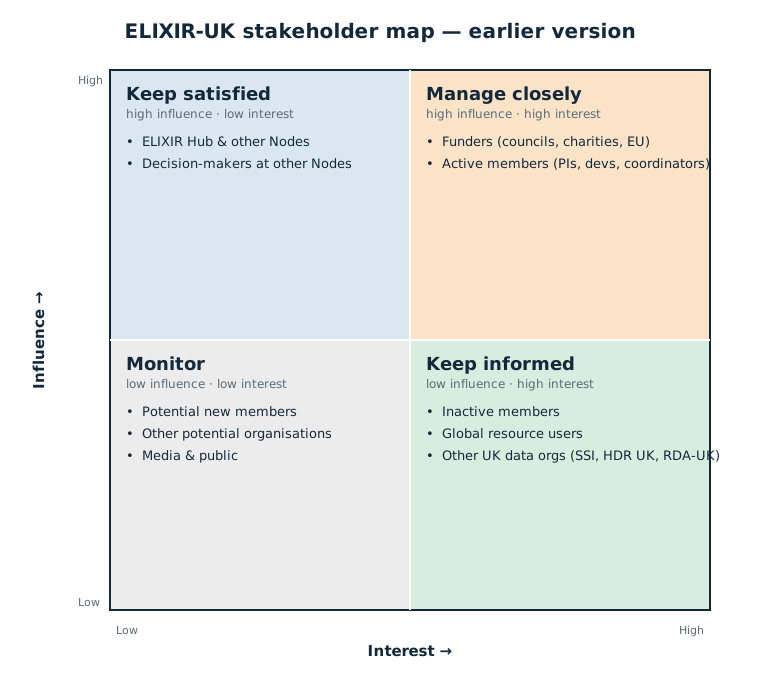
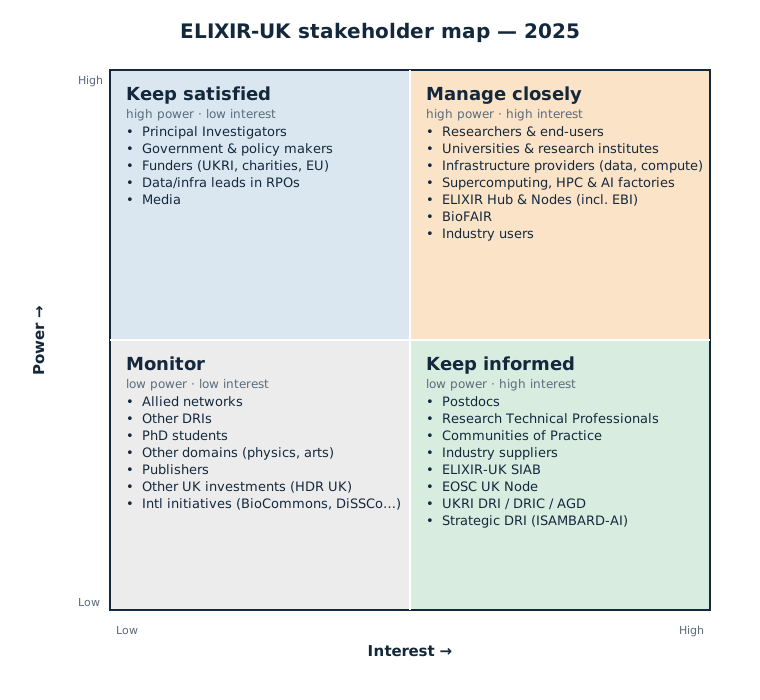
The full lists for each quadrant are in the tables below.
Earlier version
From the ELIXIR-UK handbook, mapping influence (how much an audience shapes ELIXIR-UK’s ability to deliver) against interest:
| Quadrant | Stakeholders |
|---|---|
| Manage closely (high influence, high interest) | Funders (research councils, charities, EU bodies); active ELIXIR-UK members – PIs, developers, coordinators |
| Keep satisfied (high influence, lower interest) | ELIXIR Hub and other Nodes; decision-makers at other country Nodes |
| Keep informed (lower influence, high interest) | Inactive ELIXIR-UK members; users of ELIXIR-UK resources globally; other UK data organisations (SSI, Health Data UK, RDA-UK) |
| Monitor (lower influence, lower interest) | Potential new members; other potential member organisations; media and the public |
The handbook itself calls this “a working tool, not a finished artefact” and recommends reviewing it at least annually.
2025 version
The 2025 map was produced at a workshop to build a Theory of Change for ELIXIR-UK, which brought together key contributors and advisors – including members of the Node’s Scientific and Industry Advisory Board (SIAB). Revisiting the stakeholder map was part of that wider strategic exercise: the map shifted because the strategy did.
Redone at the ELIXIR-UK Strategy Meeting on 28 November 2025, it maps power against interest:
| Quadrant | Stakeholders |
|---|---|
| Manage closely (high power, high interest) | Researchers & end-users; universities & research institutes; infrastructure providers (data, compute); supercomputing centres, HPC & AI factories; ELIXIR Hub & Nodes (incl. EBI); BioFAIR; industry users |
| Keep satisfied (high power, low interest) | Principal Investigators; government & policy makers; funders (UKRI, charities, EU); data/infrastructure leads in RPOs; media |
| Keep informed (low power, high interest) | Postdocs; Research Technical Professionals (data stewards, technicians, RSEs, librarians); existing Communities of Practice; industry suppliers; ELIXIR-UK SIAB; EOSC UK Node; UKRI DRI / DRIC / AGD programmes; interfaces to strategic DRI (ISAMBARD-AI, thematic infrastructures) |
| Monitor (low power, low interest) | Allied networks; other DRIs; PhD students; similar organisations in other domains (physics, arts); publishers; other UK investments (HDR UK); international initiatives (Aus BioCommons, DiSSCo, EOSC LS Node, EuroBioImaging) |
What changed, and why it matters
The 2025 map is broader and more national:
- A new funding grant in 2025 brought capacity to support researchers and technical professionals directly, so they became a primary focus rather than a “keep informed” audience.
- UKRI’s DRI programmes, EOSC UK Node, supercomputing/AI infrastructure and strategic DRIs entered the map – shift toward national-level intervention.
None of this means the earlier map was “wrong.” It was right for its time. The map changed because the organisation changed – which is exactly what it’s supposed to do.
Review your map when something shifts: a new grant, a change of remit, a new partnership or a big external event. Treat it as a snapshot of where to focus now, not a permanent classification of people.
Use it for your Node
See Chapter 2: Understanding your audience for how to build your own priority matrix and persona, and remember: the goal is to focus effort, then revisit it as your Node evolves.